
How we roast · Lexington, South Carolina
Eleven minutes decide the whole cup.
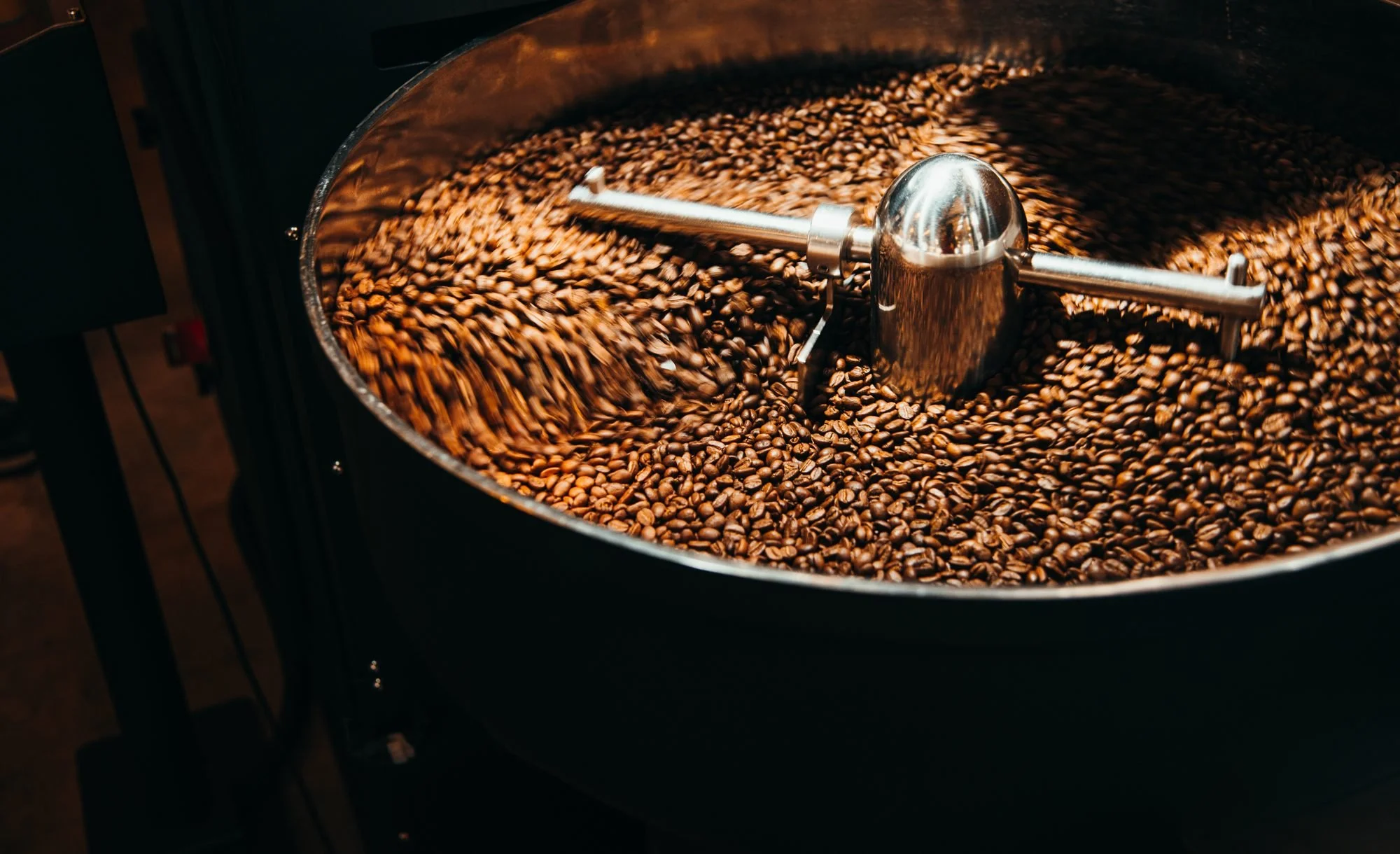
Roasting is not cooking. It is a controlled chemical reaction with a clock on it, and every choice we make inside that window is already in your grinder by the time you open the bag.
The short version
Green beans have no flavour yet.
A raw coffee seed smells like hay and grass. Every note you eventually taste, the tangerine, the cocoa, the almond, the caramel, is manufactured during the roast out of the sugars and acids the farm put there.
That is the roaster's actual job. Not to darken a bean, but to develop what is already inside it and stop at the exact moment it is most itself. Stop early and it tastes like raw peanut. Go long and you taste the roast instead of the coffee.
Water leaves first
A green bean is roughly 11 percent moisture. None of the flavour chemistry can start until most of that water is driven off.
Sugars meet amino acids
The Maillard reaction, the same one that browns a steak or a crust of bread. It builds the nutty, chocolate, bready layer.
Caramelization
Sugars break down into caramel and toffee compounds. Push it too far and those same compounds turn to carbon and ash.
The drop
Beans hit the cooling tray and airflow pulls the heat out fast. A slow cool is a roast that keeps going without you.
The profile
This is what we are actually steering.
Every batch gets logged as a curve. Bean temperature climbing over time, and underneath it the rate of rise, how many degrees per minute the bean is gaining. Step through it.
Charge
- Time
- Bean temp
- Rate of rise
Listen for
Temperatures shown are typical for a small drum batch and will shift with bean density, moisture content and batch size. The shape of the curve is the part that stays constant: a steady climb with a rate of rise that only ever falls.

A roast you cannot repeat is not a profile. It is an accident.Working rule of the bench
The method
One variable at a time. Every time.
Thirty two years of running mechanical systems teaches you one thing above all others: if you change three things and the result improves, you have learned nothing. You cannot repeat it and you cannot fix it when it drifts.
So a dial-in here moves one setting per batch. Charge temperature, or airflow, or the time between first crack and drop. Never two. Then we cup it against the batch before it and the difference belongs to that one change.
Log it
Charge temp, turning point, time and temperature at first crack, drop time, development ratio, weight loss. Written down, every batch, no exceptions.
Change one thing
The next batch moves a single input. Everything else is held exactly where it was.
Cup it blind
Side by side against the previous roast. If the change did not show up in the cup, it was not worth making.
Lock or back it out
Better, it becomes the new baseline. Worse, it goes back and gets noted so it is not tried twice.
Things people get told
Four ideas worth putting down.
"Dark roast is stronger coffee."
What is actually trueCaffeine is roughly a wash between light and dark, and by weight a dark roast has slightly less, because roasting burns off mass. What dark roast delivers is bitterness and smoke, not strength. Strength is a brewing variable: how much coffee you use against how much water.
"Fruity means weak or sour."
What is actually trueThose are the fruit acids the coffee cherry actually contained, surviving the roast instead of being cooked out of it. Sour is a defect, usually underdeveloped roasting or under extraction in the brew. Bright is a feature. They are not the same thing.
"Oily beans mean fresh beans."
What is actually trueOil on the surface means the roast went far enough to push the lipids out through the bean wall. It is a marker of roast level, not freshness, and that exposed oil goes rancid faster than oil still sealed inside the bean.
"Roasting is mostly about the machine."
What is actually trueThe machine sets your ceiling. The log sets your floor. A careful roaster on a modest drum with a written profile will beat a careless one on expensive equipment every single time, because the careful one can do it again tomorrow.


Roasted to a number, not a guess.
Every bag carries the roast date. Every profile behind it carries a log. That is the whole promise.